
Why Companies Are Racing to Secure Big-Box Warehouses Across Four Key U.S. Cities

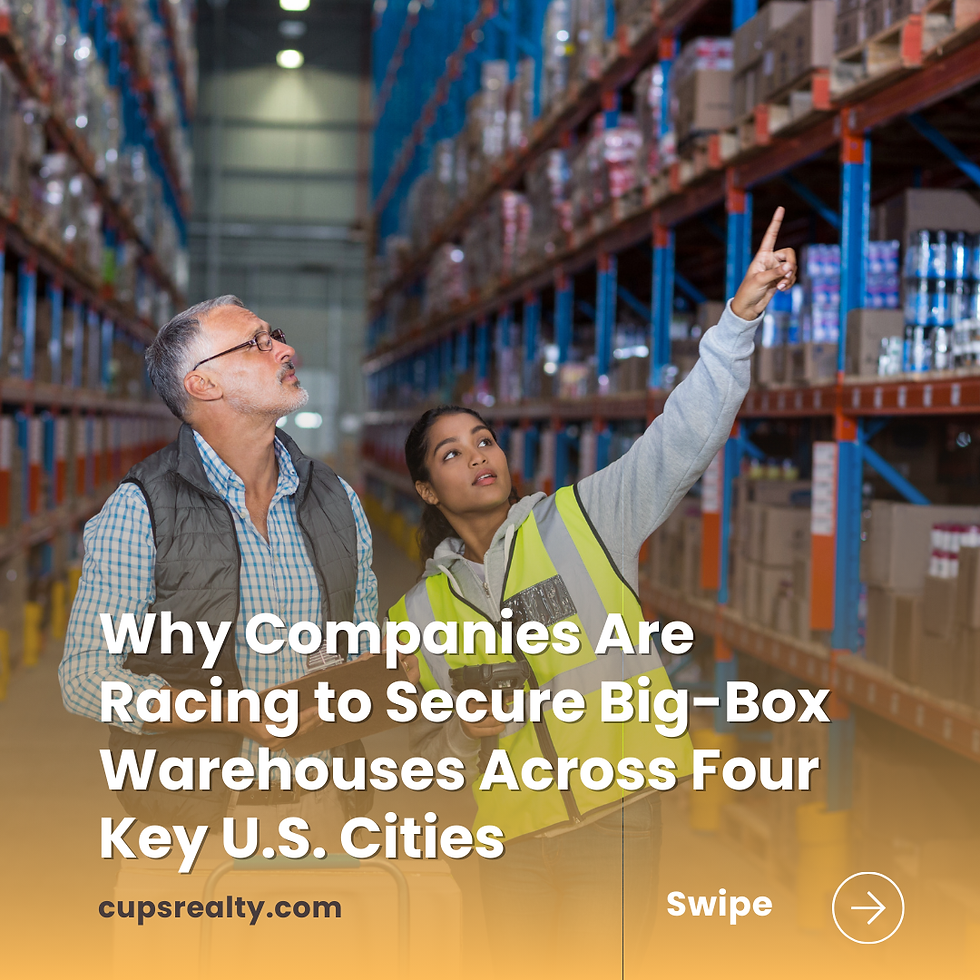
Recent leasing data shows four standout markets for large warehouses: Oklahoma City, Nashville, Richmond and Columbus.
Oklahoma City Warehouses
A market dominated by owner-users, so leasable space is naturally tight.
Hobby Lobby alone controls 11M+ sq ft and added another 1.9M sq ft facility last year.
Spec buildings lease quickly to major users like Amazon and Walmart.
Big-box leasing is up 56% vs. pre-pandemic.
Nashville Warehouses
One of the fastest-growing warehouse markets since 2010, adding 35M+ sq ft.
Despite heavy construction, demand stays strong:
Leasing above 100k sq ft is 56% higher than the 2015–2019 average, and vacancy only rose about 3% since 2020.
Richmond Warehouses
Strong in both big-box and small-bay segments.
Big-box vacancy is only 7.2%, just 2% above the 2021 low.
New builds lease fast — only 15% of post-2021 inventory remains vacant.
Lower costs and I-95 access draw major tenants such as Amazon, Lowe’s and Trader Joe’s.
Columbus Warehouses
A Midwest logistics hub with direct access to I-70, I-71 and I-270.Stable population and job growth support consistent industrial demand.
Ranks top-10 nationwide for leases above 50k sq ft.
These four cities win because demand is real, new buildings get leased quickly, and their logistics networks support large-scale distribution. If you’re choosing a U.S. warehouse location, they’re the markets worth benchmarking.


Comments